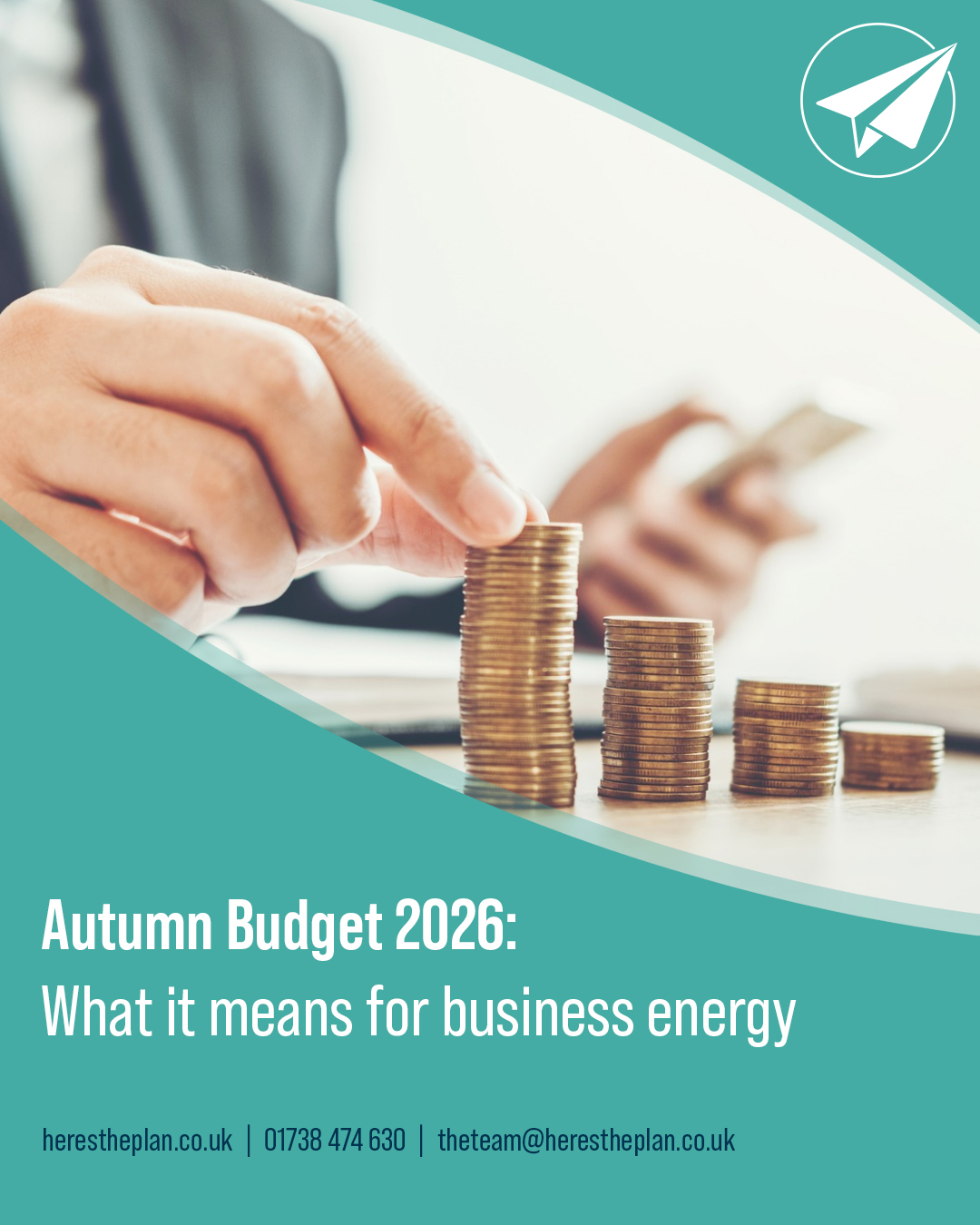
Budget day is done. Here’s the plan for what it means for your business energy costs.
The headline: it’s a mixed bag. Electricity gets a bit of long-term certainty. Gas doesn’t. And a few of the biggest changes are aimed at households rather than businesses.
Climate Change Levy (CCL): electricity gets a freeze, gas doesn’t
The Climate Change Levy (CCL) is a tax on business energy use. Here’s where the rates are heading:
Fuel | Current rate | From April 2027 | From April 2028 |
Electricity | 0.801 p/kWh | 0.827 p/kWh | 0.827 p/kWh (frozen) |
Natural gas | 0.801 p/kWh | 0.827 p/kWh | 0.853 p/kWh |
LPG | 2.175 p/kg | 2.175 p/kg | 2.175 p/kg (frozen) |
Other taxable fuels | 6.264 p/kg | 6.468 p/kg | 6.669 p/kg |
Electricity and Liquefied Petroleum Gas (LPG) rates freeze from April 2028 at 2027/28 levels. Gas and other taxable fuels keep rising in line with the Retail Prices Index (RPI), the government’s inflation measure.
Carbon Price Support to be abolished
From 1 April 2028, the government will abolish Carbon Price Support, a tax on fossil fuels used to generate electricity in Great Britain. We expect this to ease wholesale electricity costs. Gas will still influence your bill. When gas-fired power stations are the last to switch on to meet demand, they set the wholesale electricity price for everyone.
Help for energy-intensive businesses
The British Industrial Competitiveness Scheme is now open for applications. From 1 April 2027, eligible businesses in Great Britain will be exempt from the indirect costs of the Renewables Obligation, Feed-in Tariffs and the Capacity Market. Eligible businesses will also receive an additional payment in 2027 to reflect support they would have received had the scheme started sooner. Northern Ireland is being funded to deliver a comparable scheme.
If your business is energy-intensive, check your eligibility now. Current eligible HTP clients will be contacted by their dedicated Account Manager if they fall into this scheme.
0% VAT on “domestic” electricity extended, and it may include you
The 0% VAT rate on domestic electricity now runs until 30 June 2027. The name is misleading. Smaller business supplies are treated as domestic if they fall below these thresholds:
- Electricity: average consumption of 33 kWh a day, or up to 1,000 kWh a month. Qualifying supplies get 0% VAT and no CCL.
- Gas: average consumption of 145 kWh a day, or up to 4,397 kWh a month. Qualifying supplies stay at 5% VAT, with no CCL.
One catch. If you’re VAT-registered and can fully recover your input VAT, the 0% rate offers little or no net benefit.
Other changes worth knowing
- Gas Shipper Obligation: the government proposes to scrap this planned new tax on gas bills. Instead, it will publicly fund Hydrogen Allocation Round 1 contracts and any future hydrogen contracts.
- Cost Control Framework: no new policy costs will go onto bills until a framework is in place at the 2027 spending review. It will set budgets for the components of energy costs.
- Contracts for Difference (CfD): a consultation on wholesale CfDs is open. These fix the price paid to some renewable projects to protect against volatile gas prices.
- Electricity Generator Levy: this rises from 45% to 55% from July 2026, applying to exceptional revenues earned by certain generators.
- Fuel duty: the 5p cut is extended to 1 July 2027, and the planned RPI increase is deferred to the same date.
- Domestic standing charges: the government has asked Ofgem to remove gas standing charges for around 23 million households by the end of 2027, with electricity reform promised. This looks aimed at households, so we don’t expect it to change business bills.
- £100 Household Energy Payment: households in Council Tax bands A to D in England will receive a one-off £100 payment this winter, and the Scottish, Welsh and Northern Ireland governments will get their share of the funding. This one is for households, not businesses.
Here’s The Plan
Review your contract. Levies like CCL are set by government, so no contract can fix them. Your energy price is a different story. Check how your contract treats pass-through costs, and look at how and when you buy. Our flexible purchasing options spread buys across your contract term to manage the wholesale element.
Check your invoices. Rate changes mean more room for error. Our Invoice Validation checks every bill against your contract and meter data.
Check your eligibility. Whether it’s the British Industrial Competitiveness Scheme or the 0% VAT thresholds, we can help you find out.
Cut your usage. The best way to beat a levy is to use less energy. Our Sustainability team can help with LED lighting, voltage optimisation and submetering.
How is your business planning for energy costs in 2027? We’d love to hear, and we’re always here to help.
 theteam@herestheplan.co.uk
 01738 474 630
Sources:
https://www.gov.uk/government/collections/budget-2026-in-full
https://www.gov.uk/government/news/what-the-autumn-budget-2026-means-for-your-energy-bills